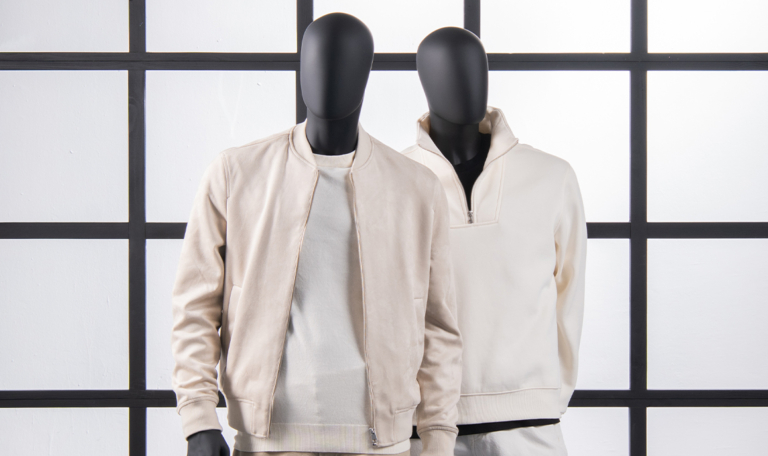
Polystyrene is considered a more sustainable option for mannequin production primarily because it is 100% recyclable and can go through multiple recycling cycles without losing its core material value. Unlike fiberglass or polyurethane, which dominate conventional mannequin production and are difficult or impossible to recycle, polystyrene supports a genuine closed-loop model where old mannequins become raw material for new ones. Below, we break down the specific reasons polystyrene stands out, from end-of-life recycling to what this means for your ESG reporting.
How is polystyrene recycled at the end of a mannequin’s life?
When a polystyrene mannequin reaches the end of its useful life, it can be mechanically recycled, meaning it is ground down and reprocessed into raw polystyrene material that can be used again. This is the most widely available and cost-effective form of plastic recycling, which makes it practical at scale rather than theoretical. The recycled material can feed back into mannequin production directly, or it can be used in other product categories.
This closed-loop potential is what separates polystyrene from many other mannequin materials. With fiberglass, for example, the composite structure of glass fibers bonded in resin makes separation and recycling extremely difficult. Once a fiberglass mannequin reaches the end of its life, it typically ends up in a landfill. Polystyrene avoids that outcome entirely, provided the right infrastructure is in place to collect and process it.
It is worth noting that recyclability only delivers real environmental benefit when manufacturers and retailers actively build recycling into their processes. This means working with suppliers who have a clear material strategy, not just a claim on a product sheet.
What makes polystyrene a lower-impact material than alternatives?
Polystyrene has a lower environmental impact than fiberglass and polyurethane primarily because it is fully recyclable, supports mechanical processing, and does not require the same energy-intensive or chemically complex manufacturing steps that composite materials demand. It also avoids the toxic resin systems associated with fiberglass production, which carry both air quality and worker health implications during manufacturing.
The comparison with fiberglass is particularly relevant because fiberglass remains the dominant material for mannequins produced in large volumes in Asia. Fiberglass mannequins are thought to be lightweight and durable which in most cases is not true as weight heavily impacts durability. In addition, the material is a thermoset composite, meaning its components are chemically bonded during curing and cannot be separated or recovered after the fact. Polyurethane faces similar limitations.
Polystyrene, by contrast, is a thermoplastic. It softens when heated and can be reprocessed repeatedly without losing its fundamental chemical structure. This is the property that makes mechanical recycling viable and repeatable. For retailers thinking about sustainable retail display materials, this distinction matters because it determines whether your supplier’s sustainability claims hold up at the end of the product’s life, not just at the point of manufacture.
Manufacturing location also plays a role. Producing mannequins closer to the markets they serve reduces transportation-related emissions significantly. A European manufacturer working with a localized supply chain generates a smaller freight footprint than one shipping finished goods from the other side of the world, even before you account for material differences.
How does polystyrene hold up over a mannequin’s full lifespan?
Polystyrene mannequins are very durable under normal retail conditions and maintain their structural integrity throughout a standard product lifespan. This durability is relevant to sustainability because a longer-lasting mannequin means fewer replacements, less material consumption over time, and a lower overall environmental footprint per year of use.
Durability and recyclability are sometimes treated as competing priorities in material selection, but with polystyrene, they work together. The material holds up well in typical store environments, and when it does eventually need replacing, the old unit can be recycled rather than discarded. This combination makes the total lifecycle of a polystyrene mannequin more resource-efficient than alternatives that either degrade faster or cannot be recovered at end of life.
For visual merchandising teams managing large store networks, this has a practical implication: you are not choosing between quality and sustainability. A well-manufactured polystyrene mannequin delivers consistent performance across a retail environment while supporting your brand’s commitments to retail display production sustainability.
What sustainability certifications should retailers look for in mannequin suppliers?
When evaluating mannequin suppliers on sustainability grounds, the most useful certifications to look for are EcoVadis ratings, FSC certification for packaging and wood-based materials, and evidence of verified GHG emissions tracking with documented reduction targets. These indicators show that a supplier has submitted to independent assessment rather than relying on self-reported claims.
Here is what each of these signals tells you in practice:
- EcoVadis rating: EcoVadis assesses companies across environment, labor and human rights, ethics, and sustainable procurement. A Silver Medal or above places a company in the top tier of assessed businesses globally and indicates a systematic, audited approach to sustainability rather than a marketing position.
- FSC certification: The Forest Stewardship Council certifies that wood and paper products, including packaging, come from responsibly managed sources. For mannequin suppliers, this applies to cardboard packaging and any wood-based components or display accessories.
- GHG emissions reporting: Suppliers who measure and report Scope 1 and Scope 2 greenhouse gas emissions annually, and who set binding reduction targets, demonstrate a level of environmental accountability that goes beyond surface-level claims. Look for targets tied to specific baselines and timelines, not open-ended commitments.
- Renewable energy sourcing: Suppliers who power their production using renewable electricity reduce the carbon intensity of every unit they produce. This is increasingly relevant as retailers calculate their own Scope 3 emissions, which include emissions from suppliers.
- Low-emission materials: Certification that raw materials meet low-emission standards, and that paints and finishes use water-soluble formulations rather than solvent-based ones, reflects responsible sustainable fixture manufacturing practice at the production level.
The practical advice here is to ask suppliers for documentation rather than accepting general statements. A supplier with genuine credentials will be able to share their EcoVadis scorecard, their emissions data, and their material certifications without hesitation.
How does choosing sustainable mannequins affect a retailer’s ESG goals?
Choosing mannequins made from recyclable materials and produced by a supplier with verified sustainability credentials directly supports a retailer’s ESG goals by reducing Scope 3 emissions, improving supply chain transparency, and providing concrete evidence of responsible sourcing for ESG reporting. For retailers with public sustainability commitments, the supply chain is increasingly where those commitments are tested.
Scope 3 emissions, which cover indirect emissions from a company’s value chain including purchased goods and services, are often the largest and hardest-to-address part of a retailer’s carbon footprint. Switching to eco friendly mannequins produced with renewable energy and low-emission materials is a measurable action that reduces this exposure.
Beyond emissions, ESG frameworks increasingly assess supply chain labor standards, material transparency, and end-of-life product management. A mannequin supplier that operates in alignment with the UN Global Compact, prohibits forced and child labor, and maintains occupational health and safety protections for its workforce contributes to the social pillar of your ESG reporting, not just the environmental one.
For visual merchandising and procurement teams, this means that the mannequin buying decision is no longer purely an aesthetic or commercial one. It is a supply chain decision with ESG implications, and the supplier you choose either supports your reporting or creates a gap in it.
At IDW Display, this is exactly the approach we take to renewable energy manufacturing and material responsibility. Our mannequins are made from 100% recyclable polystyrene, our production runs on renewable electricity, and our sustainability performance is independently assessed through EcoVadis. If you want to understand how our production model aligns with your ESG requirements, you can read more about our sustainability approach or get in touch with our team to talk through your specific needs.
Frequently Asked Questions
Can polystyrene mannequins be recycled directly through our existing store waste streams?
In most cases, polystyrene mannequins cannot be dropped into standard kerbside or store recycling bins — they require a dedicated collection and processing route. The most practical approach is to work directly with your mannequin supplier to arrange a take-back or end-of-life collection programme, which the best suppliers will already have in place. Establishing this agreement at the point of purchase, rather than when mannequins are ready to be retired, ensures the closed-loop benefit actually materialises rather than remaining theoretical.
How do we transition from an existing fiberglass mannequin fleet to polystyrene without disrupting our store environments?
The most manageable approach is a phased rollout tied to your natural replacement cycle — retiring fiberglass units as they reach end of life and replacing them with polystyrene equivalents, rather than attempting a full swap in one go. Work with your supplier to ensure the new mannequins match your existing aesthetic requirements in terms of finish, pose range, and sizing, so the transition is invisible to customers. Many suppliers can provide samples or pilot units for a small number of stores before you commit to a wider rollout, which reduces both commercial and operational risk.
What questions should we ask a mannequin supplier to verify their sustainability claims are genuine?
Ask for documentation rather than accepting verbal or marketing-level assurances. Specifically, request their EcoVadis scorecard or equivalent third-party audit results, their annual GHG emissions data with Scope 1 and Scope 2 breakdowns, evidence of renewable energy use in production, and their material certifications for both the mannequin body and packaging. A supplier with credible sustainability credentials will share this information readily and without hesitation — reluctance or vague responses to these questions is itself a useful signal.
How do we account for mannequin procurement in our Scope 3 emissions reporting?
Mannequins fall under Scope 3 Category 1 — Purchased Goods and Services — which means the emissions embedded in their production, materials, and transport count toward your supply chain footprint. To calculate this accurately, you need emissions data from your supplier, including the carbon intensity of the materials used and whether production is powered by renewable or fossil-fuel-based electricity. Suppliers who already track and report their own GHG emissions will be able to provide the activity data you need, making your Scope 3 calculations far more accurate than relying on generic industry averages.
Are there any scenarios where polystyrene mannequins are not the right sustainable choice?
Polystyrene is an excellent choice for the vast majority of standard retail display applications, but it is worth considering whether specialist requirements — such as extreme outdoor exposure or very heavy load-bearing configurations — call for a different material. In those cases, the sustainability trade-off should be evaluated honestly rather than defaulting to a material that may not perform adequately, since a shorter lifespan due to poor material fit ultimately means more frequent replacement and higher total resource consumption. For most indoor visual merchandising environments, however, polystyrene delivers the right combination of durability, aesthetics, and end-of-life recyclability.
How does the manufacturing location of a mannequin supplier affect our overall sustainability footprint?
Transportation is a meaningful but often overlooked part of a mannequin’s total environmental footprint, particularly for retailers sourcing from suppliers based in Asia, where the dominant fiberglass production is concentrated. Freight emissions — especially sea freight over long distances — add to the embedded carbon of every unit before it even reaches your store. Choosing a supplier based closer to your markets, such as a European manufacturer for European retail networks, can significantly reduce this transport-related footprint and also shortens lead times, which has practical operational benefits alongside the environmental ones.
Can sustainable mannequin choices contribute to our social ESG commitments, not just the environmental ones?
Yes — the social dimension of ESG is increasingly scrutinised in supply chain assessments, and your mannequin supplier’s labour practices are part of that picture. Suppliers who operate in alignment with frameworks such as the UN Global Compact, maintain verified occupational health and safety standards, and have clear policies prohibiting forced and child labour contribute directly to the social pillar of your ESG reporting. When evaluating suppliers, ask whether their labour and human rights practices are independently assessed — EcoVadis, for example, covers this alongside environmental performance — so you have documented evidence rather than self-reported assurances.
Related Articles
- How are retailers making their store environments more sustainable?
- What role does visual merchandising play in a retailer's sustainability story?
- How are retailers setting and reporting on sustainability targets for their physical stores?
- How does store layout and design contribute to overall sustainability goals?
- How is the retail display industry responding to demand for more sustainable products?
- How are retailers using third party certifications to validate their sustainability claims?
- How are premium retailers balancing quality and sustainability in their store environments?
- What pressure are VM teams facing around sustainability?
- How are European retailers approaching sustainability in their physical environments?
- How can retailers minimise the footprint of a store rollout across multiple locations?
- How do retailers measure the environmental impact of their store operations?
- What is the golden zone in retail product presentation?
- Why do some in-store displays fail to convert browsers into buyers?
- What makes a window display visually compelling to passersby?
- How do you create a cohesive visual story across multiple store zones?