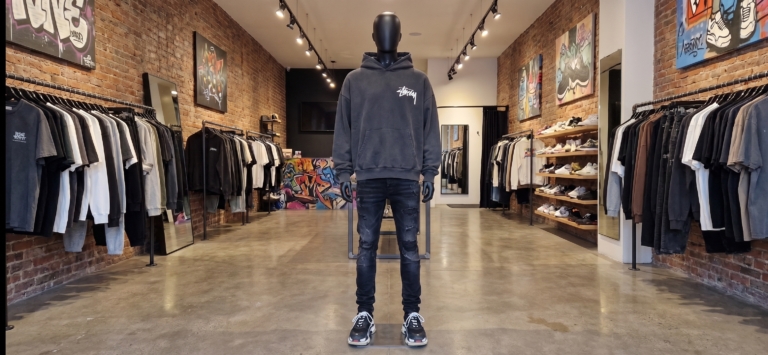
Fashion retail displays differ significantly between luxury and high-street market stores, and the gap goes far beyond budget. Luxury retail prioritizes exclusivity, craftsmanship, and emotional storytelling, while high-street market and fast fashion retail focus on volume, versatility, and speed of change. The right display strategy depends entirely on what your brand wants shoppers to feel the moment they walk through the door. Below, we break down the key differences across goals, mannequin styles, materials, refresh cycles, sustainability, and how to choose the right production partner.
What visual merchandising goals separate luxury from high-street market retail?
Luxury retail displays are designed to slow shoppers down and create a sense of desire and exclusivity. High-street market displays are designed to move shoppers through the store efficiently and highlight volume, variety, and value. These are fundamentally different goals, and they shape every decision from mannequin pose to fixture placement.
In a luxury environment, the display itself is part of the product story. A single beautifully styled mannequin in a window might represent hours of creative direction, custom sculpting, and deliberate lighting. The goal is to make the shopper feel something specific, often aspiration or belonging to a particular world.
In fast fashion retail, the goal shifts toward clarity and throughput. Displays need to communicate newness, accessibility, and range. Shoppers move faster, visit more frequently, and expect to see fresh product regularly. Visual merchandising here is more about guiding attention than creating a mood.
How do mannequin styles differ between luxury and fast fashion stores?
Luxury stores tend to use highly individualized, often abstract or artistic mannequins with custom poses, unique facial features, and refined finishes. Fast fashion stores typically use versatile, neutral mannequins in standard poses that work across a wide range of garments and can be repositioned quickly as collections rotate.
In luxury retail, the mannequin is often considered part of the brand identity. Retailers commission bespoke figures with specific proportions, skin tones, or even distinctive styling details that align with their creative direction. These mannequins are not swapped out frequently. They are chosen to last and to represent the brand consistently over time.
Although not universally, fast fashion mannequins, on the other hand, tend to be practical above all. They are repositioned regularly, dressed and undressed by store staff at high frequency, and need to hold up to heavy use. Neutral, abstract faces and clean finishes work well here because they do not compete with the garments and are easy to style in multiple ways.
What materials and finishes are used in high-end versus high-street market displays?
High-end retail displays often feature premium finishes such as matte lacquers, metallic coatings, custom skin tones, and hand-applied details. Mass market displays prioritize durable, consistent finishes that hold up to frequent handling, typically in neutral tones that work across many product categories.
The choice of finish in luxury retail is a deliberate branding decision. A champagne metallic or a deep matte black mannequin signals a specific aesthetic. These finishes are often applied by hand, require more production time, and are chosen to complement specific store environments and seasonal campaigns.
In high-street market retail, the priority is durability and consistency at scale. A chain with hundreds of stores needs mannequins that look identical across every location and survive years of daily use. Water-based paints and polishes, which are also more environmentally responsible, are increasingly common in this segment because they deliver consistent results without sacrificing quality.
Does sustainability matter differently across retail display tiers?
Sustainability is relevant across both luxury and high-street market retail, but the motivations and approaches differ. Luxury brands often connect sustainability to brand values and long-term storytelling, while mass market retailers focus more on reducing waste at scale and meeting regulatory or corporate sustainability targets.
For luxury retailers, a commitment to sustainable materials and production processes aligns naturally with a narrative around craftsmanship, responsibility, and brand longevity. Choosing recyclable mannequins or low-emission finishes becomes part of the brand story and can be communicated to customers as part of a broader values framework.
For high-street market retailers, the sustainability argument is more operational. When you are buying thousands of mannequins across hundreds of stores, the environmental impact of your display choices adds up quickly. Recyclable materials, water-soluble paints, and responsible sourcing reduce that footprint in a meaningful way. It also increasingly matters to retail employees, shoppers, and investors who are paying closer attention to how brands operate behind the scenes.
What should retailers consider when choosing a display production partner?
When choosing a production partner for fashion retail displays, the most important factors are customization capability, production speed, quality consistency, and proximity. Retailers should also look for a partner who can manage the full process from design to manufacturing to delivery, rather than one who only designs, but does not control the manufacturing process.
For luxury retailers, the ability to develop truly bespoke designs is non-negotiable. You need a partner with experienced sculptors and designers who understand your aesthetic and can translate a creative brief into a finished mannequin that feels right for your brand. Close collaboration during the development phase matters more than price.
For high-street market retailers, scalability and reliability are the priorities. You need a partner who can produce large volumes consistently, hit tight delivery windows, and maintain quality across every unit. A European manufacturing base is a real advantage here, reducing lead times compared to overseas suppliers and making communication and quality control far more straightforward.
At IDW Display, we work with both luxury and mass market retailers across more than 35 countries, offering everything from fully custom bespoke mannequins to scalable production runs for large retail chains. Whether you need a single sculptural centrepiece or thousands of consistent display figures, we handle the entire process in-house, from the first design conversation to delivery at your door.
Frequently Asked Questions
Can a mid-market retailer adopt luxury display techniques without overspending?
Absolutely. Mid-market retailers can borrow selectively from luxury visual merchandising by investing in one or two hero display moments, such as a styled window or a focal point mannequin with a premium finish, while keeping the rest of the store functional and cost-efficient. The key is intentionality: choosing where to elevate the experience rather than trying to apply luxury principles across every fixture. Even small upgrades like a matte finish or a more expressive mannequin pose can signal quality without requiring a full luxury budget.
How do I brief a display production partner if I have never commissioned custom mannequins before?
Start by gathering visual references that reflect your brand aesthetic, including campaign imagery, mood boards, and examples of displays you admire, even from other industries. From there, a good production partner will guide you through decisions around pose, proportion, finish, and face treatment. You do not need to have all the answers upfront; the development phase exists precisely to translate a creative direction into a manufacturable product. The more clearly you can articulate how you want shoppers to feel, the better the outcome.
What are the most common mistakes retailers make when planning a display refresh?
The most frequent mistake is leaving display planning too late, treating it as an afterthought rather than integrating it with the broader campaign or product launch timeline. This creates rushed decisions, missed customization opportunities, and inconsistent execution across store locations. Another common pitfall is prioritizing upfront cost over total cost of ownership: cheaper mannequins that wear poorly or require frequent replacement often end up costing more in the long run than a durable, well-finished unit purchased at a higher initial price.
Are sustainable display materials noticeably different in appearance or durability compared to conventional ones?
In most cases, no. Modern water-based paints and recyclable base materials have advanced significantly and can achieve the same range of finishes, from high-gloss to deep matte, as conventional alternatives. For high-street market retailers especially, these materials now meet the durability standards required for high-frequency handling. For luxury finishes, some hand-applied techniques still require traditional materials, but many premium effects can be achieved sustainably with the right production expertise.
What is the typical lead time for custom mannequin production, and how far in advance should I plan?
For fully bespoke mannequins involving original sculpting and custom finishes, lead times typically range from 8 to 16 weeks depending on complexity and production volume. Standard or semi-custom options with existing base forms and modified finishes can often be turned around in 6 to 8 weeks. As a rule of thumb, if your display refresh is tied to a seasonal campaign or store opening, brief your production partner at least three to four months in advance to allow time for design development, sampling, and any revisions before final production begins.
Can the same mannequin range work across both in-store and window display applications?
Often yes, but there are important considerations. Window displays are exposed to stronger light, including direct sunlight, which can fade certain finishes over time and requires UV-resistant coatings for long-term use. Poses that read well at a distance and in profile are also more effective in windows than poses designed for close-up interaction on the sales floor. If you are planning to use mannequins across both contexts, discuss this with your production partner early so the finish and pose selection can be optimized for both environments from the outset.
Related Articles
- What should retailers know about how their store displays are produced?
- What do shoppers expect from retailers when it comes to sustainability in stores?
- How do retailers measure the environmental impact of their store operations?
- What sustainability commitments are retailers making for their physical stores?
- How do you use props effectively in retail display design?
- What is the impact of display height on product visibility?
- How does product placement hierarchy work in a retail store?
- How do you choose the right mannequin for a retail display?
- What is the difference between in-store displays and window displays?
- What role does signage play in visual merchandising strategy?
- How do you use storytelling in retail display design?
- What visual merchandising techniques work best for fashion retailers?
- How does shopper flow influence store layout decisions?
- What is the decompression zone in retail store layout?
- How does sensory merchandising work alongside visual display strategy?